Keeping the Spark Cool: A Tale of Two Nodes and a British Summer
Table of Contents
You know it’s a proper British summer when the Met Office is issuing records and your DIY rack build is sweating.
Turns out Tuesday 26 May 2026 is officially the hottest May day ever recorded in the UK. 35.1°C at Kew Gardens in London. The day before had already broken the previous record (34.8°C, also Kew Gardens), making it the second consecutive day the May and spring temperature record was provisionally shattered. Parts of Britain hit heatwave thresholds — the kind of temperatures we normally associate with mid-July, not the end of May.
And somewhere in the middle of it all, my two-node DGX Spark cluster is sitting on my desk, processing token after token of model output, getting hotter by the hour.
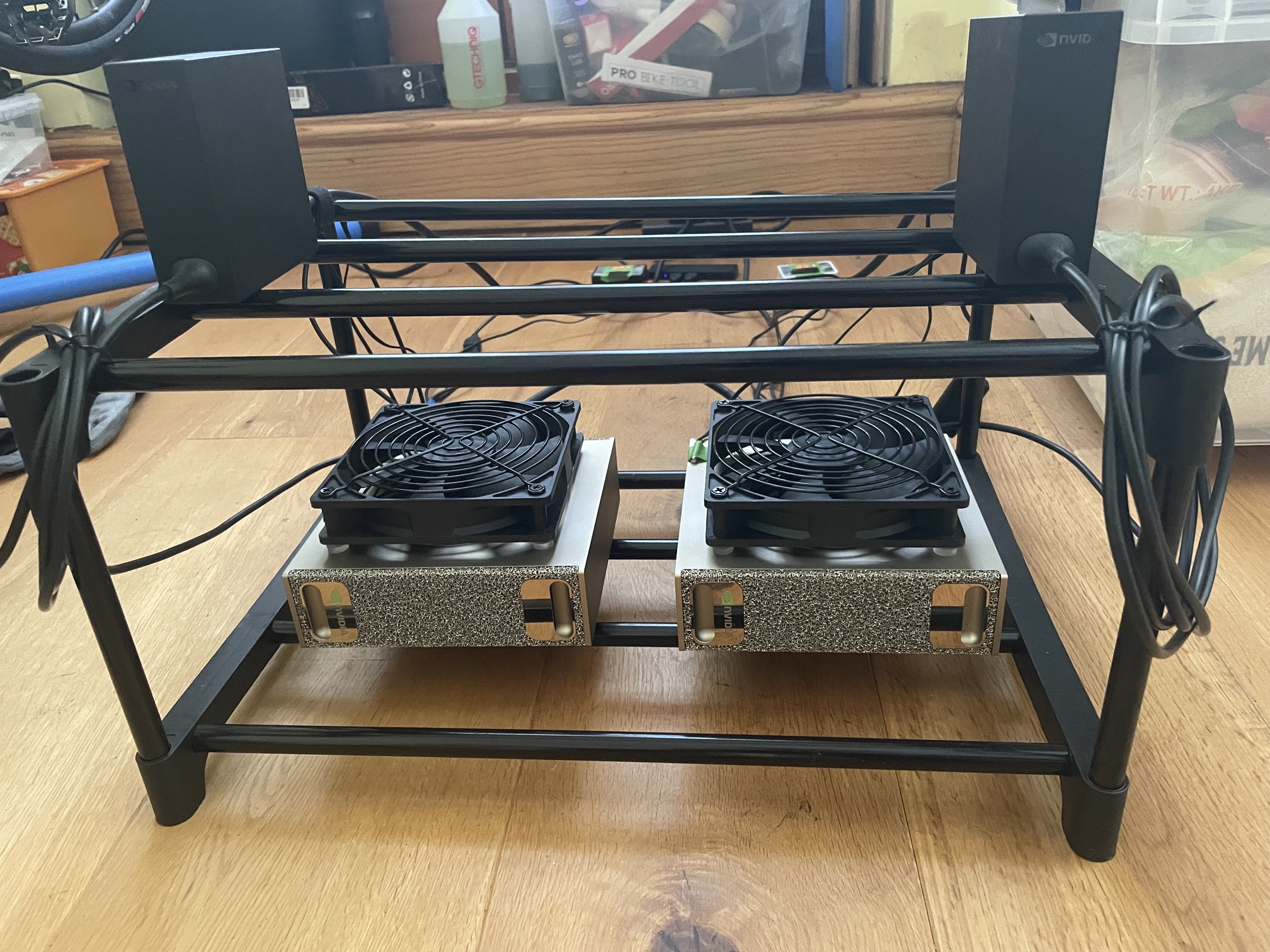
The two-node DGX Spark cluster — currently learning about thermodynamics the hard way.
The Rack Build Was a Good Idea
A couple of months back, after unboxing my first DGX Spark (see the previous post), I couldn’t resist the temptation. One is great. Two is slightly more than double the fun. So I built a rack — borrowed the idea from the proper server aisle, adapted it for a desk, and mounted both units side by side in a compact vertical stack.
I’ve got two USB PC fans sitting on top of the Sparks to keep things cool during heavy inference or under heavy load. They’re not exactly server-grade cooling, but they do something.
The Heat Problem
When it’s 15°C in the room, a DGX Spark running inference or training sits at a cosy operating temperature. When it’s 25°C (and getting there on this bank holiday weekend), things start to shift. And at 35°C ambient? Let’s just say the GB10 superchip is about to learn what its thermal throttling curves feel like.
Add two of them in a closed vertical rack, and you’ve got a microclimate of your own making.
The Solution Wasn’t Complicated
The answer wasn’t thermal paste (yet) or some clever heatsink hack. It was much simpler than that.
I moved the rack.
Away from the desk, away from the window that’s currently letting in direct sunlight, away from whatever corner of the room the afternoon sun has chosen to invade. The two-node cluster now lives on the floor in the darkest, coolest corner of the room — the sort of spot you’d normally use for a plant that needs shade. The USB fans are still doing their thing, just not fighting the sunbeam anymore.
It’s not pretty. It’s not elegant. It’s effective.
A Note on Heat and Hardware
The May 2026 heatwave is part of a wider pattern across Europe, and Britain’s weather is changing in ways that make these records feel less like anomalies and more like a new normal. But for practical purposes — running AI locally, keeping hardware alive, staying comfortable while your models train — there are simple things you can do. Move your equipment away from the heat. Find a dark corner. Give it space.
Your DGX Spark will thank you. And so will you.
Besides, a two-node rack deserves better than to melt on a desk. Even if it doesn’t have a fan to sweat with.